A sagging floor joist can turn a small repair into a risky balancing act, especially in a crawl space or unfinished basement. You need an adjustable jack post that fits the available clearance, meets the load demands of the framing, and bears securely on a suitable surface. The options below cover different heights, head styles, locking systems, and installation tasks, from floor support to holding a cabinet or ceiling panel in place.
A Fast Comparison Of The Options

ZONEGRACE 4 Pack 11–16 Inch Adjustable Steel House Jacks, 12,000 LB Capacity

ZONEGRACE 4 Pack 16–21 Inch Adjustable Steel House Jacks, 12,000 LB Capacity

Bldewstg 4 Pack 11–16 Inch House Leveling Jacks

Xypholth 3.5×3.5 U-Shaped House Jacks

ZONEGRACE 4 Pack 7–11 Inch Adjustable Steel House Jacks, 12,000 LB Capacity
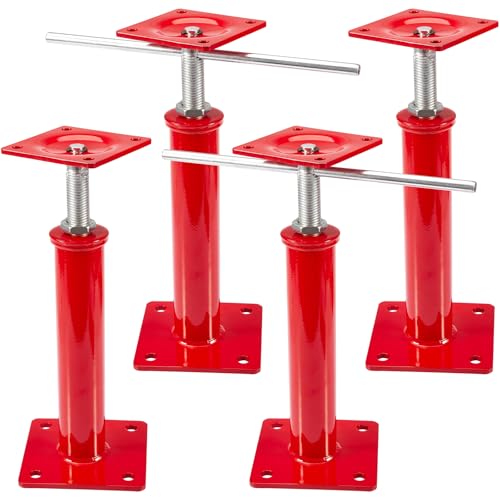
B4B BANG 4 BUCK 4 Pack 11–16 Inch House Jacks

Zhoptow Adjustable Support Pole, 45–114 Inch, 154 lb Capacity
Why These Options Stand Out
The 11–16 inch adjustment gives you useful movement between a retracted and extended position, making these posts practical for common joist and beam repairs. You can fine-tune the height as the screw turns, which is more useful than relying on a fixed-height prop.
For most crawl-space and unfinished-basement work, the steel construction and rust-resistant finish address the damp setting better than an untreated support would. The four-post set also lets you support several points without improvising separate supports, although the available clearance remains the deciding factor.
Points In Its Favor
- The 11–16 inch range covers many common framing gaps.
- Each post has a stated capacity of 12,000 pounds.
- Adjustable steel construction supports repeated positioning during a repair.
- Four posts suit projects that need support at more than one location.
Things To Consider
- Confirm that the fully extended height fits beneath your joist or beam.
- The 12,000-pound rating applies to each post and does not establish your framing’s suitability.
Quick Facts
Who It Suits Best
You benefit most from these posts when repairing typical floor framing with an 11–16 inch working gap and a need for several matched supports.
Where Another Pick Suits Better
Choose ZONEGRACE 4 Pack 7–11 Inch Adjustable Steel House Jacks, 12,000 LB Capacity for lower clearance, or the 16–21 inch model for higher framing.
Extra height makes these posts useful where the framing sits farther above the bearing surface, such as a raised beam, elevated floor, or deeper crawl-space area. Compared with the 11–16 inch ZONEGRACE set, the longer adjustment provides more room to bridge the vertical gap.
You retain the same steel construction, rust resistance, four-post quantity, and stated 12,000-pound capacity listed for the shorter version. For most structural repairs, that combination matters more than having one slightly higher maximum, so measure first and avoid extending a post beyond what your space needs.
What Earns Its Place
- A 16–21 inch range reaches higher framing spaces.
- Four matching posts simplify multi-point support work.
- The stated 12,000-pound capacity matches the other 11–16 inch ZONEGRACE set.
Practical Considerations
- Measure retracted and extended dimensions before ordering.
- Confirm the base surface, beam contact, and local project requirements before installation.
Made For
You need this range when the space between the bearing surface and supported framing falls between 16 and 21 inches.
Consider Something Else When
ZONEGRACE 4 Pack 11–16 Inch Adjustable Steel House Jacks, 12,000 LB Capacity fits better in a lower crawl space where a taller post would lack room to extend.
Separate locking screws and pins give this set a more defined holding configuration than a basic screw post without secondary restraints. You can use those pins to secure the adjusted position, which is helpful while aligning joists or supporting beams during a controlled repair.
The swiveling top is another practical detail because it can follow slight differences in alignment. Compared with the ZONEGRACE 11–16 inch model, the Bldewstg offers 11,023 pounds of stated capacity per unit, so neither has a meaningful capacity lead for ordinary framing work.
Well-Handled Touches
- Separate M22 locking screws and pins help retain position.
- A swiveling top accommodates minor alignment differences.
- Q235 steel provides a substantial core for structural support.
- The four-post pack fits common multi-point leveling layouts.
Points To Note
- The 11–16 inch range leaves little margin if your measured gap differs.
- Use only with compatible framing, stable bearing surfaces, and sound installation practices.
Technical Sheet
Right Fit For
You get the most benefit when the joist space fits 11–16 inches and your repair benefits from both a swivel head and secondary locking hardware.
Another Choice May Suit
B4B BANG 4 BUCK 4 Pack 11–16 Inch House Jacks offers a similar 11–16 inch range and swiveling head when you prefer another steel post design.
The broad U-shaped head gives the post a different job from the flat or swiveling heads used by the other floor supports. Its 3.5-by-3.5-inch cradle fits 4×2, 4×4, and 4×6 beams, helping center the wood where a small flat head might sit unevenly.
A 13–17 inch adjustment provides room for fine positioning around supported framing. For basement joists, porch beams, and similar repair areas, that centered contact may matter more than the slightly higher numerical load figures advertised by some competing posts.
The Good Stuff
- The U-shaped head centers several common beam sizes.
- The cradle reduces the need to add small shim pieces.
- A 13–17 inch range supports controlled height adjustment.
- The broad head suits joists, porch framing, and beam repairs.
Details To Watch
- Confirm that the 13–17 inch range matches your vertical clearance.
- The U-head is intended for compatible rectangular wood framing, not round posts.
Feature Snapshot
Best Suited To
You need this head style when a standard 4×2, 4×4, or 4×6 joist must sit securely within the support cradle.
Look Elsewhere When
Bldewstg 4 Pack 11–16 Inch House Leveling Jacks makes more sense for a lower opening where a 13-inch minimum is unnecessary.
Low clearance leaves little room for a post that begins too high, so the 7–11 inch range is the key feature here. You gain a compact option for shallow crawl spaces, close joist gaps, and repair points where the available space barely exceeds seven inches.
These posts otherwise share the rust-resistant steel construction and stated 12,000-pound capacity of the longer ZONEGRACE sets. Compared with the 11–16 and 16–21 inch versions, the tradeoff is reach: this model suits a smaller vertical envelope rather than elevated framing.
What Helps Most
- The short range fits compact crawl-space clearances.
- Steel construction provides a rigid screw-supported post.
- Four posts support several matching repair points.
Small Caveats
- Your gap must fall within 7–11 inches after allowing for the bearing surfaces.
- Measure closely because a deeper post may be needed for uneven terrain.
Built With In Mind
You benefit most from this short post in a crawl space where a full-size 11–16 inch model cannot extend without hitting nearby framing.
Swap It Out When
ZONEGRACE 4 Pack 16–21 Inch Adjustable Steel House Jacks, 12,000 LB Capacity is the better fit for an elevated beam or a deeper floor cavity.
The swiveling top gives these 11–16 inch posts a useful degree of movement as the screw changes their height. That matters in a tight repair area where a joist or beam may sit a little off-center from the base, and it distinguishes them from a rigid flat-headed post.
The stated 11,023-pound capacity and Q235 steel construction place them close to the Bldewstg posts in basic specifications. You also get separate M22 locking screws and pins, creating a useful middle ground between a basic adjustable post and a beam-specific U-head.
Real-World Strengths
- The swiveling top follows slight alignment differences.
- Separate M22 screws and pins help secure the setting.
- Q235 steel forms the structural body of each post.
- Four posts support several points during one project.
- The 11–16 inch range suits many common framing gaps.
Less-Strong Areas
- The head does not provide the wide cradle found on the Xypholth model.
- Your framing must fall within the stated adjustment range.
Core Details
Who Will Love This
You benefit most from a standard-height floor post that combines a swivel head with separate locking hardware.
Reach For A Different Pick When
Xypholth 3.5×3.5 U-Shaped House Jacks is the stronger choice when centering a 4×2, 4×4, or 4×6 beam matters more than a swivel top.
This support pole handles installation jobs rather than floor-jack duties. You can extend it from 45 to 114 inches, giving a cabinet, drywall sheet, or ceiling panel a temporary support while you position the work or reach the fastening points.
The 360-degree swivel lets the top follow angled surfaces, while non-slip pads help the base remain stable on a suitable floor. Its stated 154-pound capacity is modest beside the house posts, but that difference reflects a different purpose rather than a weakness in the stated design.
The Case For It
- The wide height range suits floor-to-ceiling installation work.
- A 360-degree swivel supports angled positioning.
- Non-slip pads help limit movement at the base.
- Steel rods provide the telescoping support structure.
Where It May Fall Short
- Its 154-pound capacity is unsuitable for the heavier framing loads handled by the floor posts.
- The floor and contact point must be clean, stable, and suitable for the pads.
Feature Overview
The Right Fit
You need this pole for cabinet mounting, drywall lifting, ceiling work, or another installation task below its stated capacity.
A Better Fit Elsewhere
Bldewstg 4 Pack 11–16 Inch House Leveling Jacks is the better choice for supporting floor framing rather than temporarily holding installation materials.
What Matters Before You Order
Match The Available Height
Measure the distance from the base to the underside of the framing, then compare it with the post’s full adjustment range. A 7–11 inch model needs less room to extend than a 16–21 inch model, but the final position must also leave enough room for the base and screw mechanism.
Understand The Load Figure
Load capacity is the maximum stated load for one post under its specified conditions. It does not confirm that a beam, joist, floor system, or bearing surface can carry that amount, so separate structural requirements still need verification.
Check The Head And Base
A U-shaped head suits rectangular beams by cradling and centering them, while a swivel top follows small alignment differences. The base must also be stable, and the support should make full, even contact with the framing.
Match The Tool To The Task
The six floor-jack options serve joists, beams, crawl spaces, and basements. The Zhoptow pole takes a different role, supporting cabinets, drywall, and ceiling panels during installation rather than carrying structural framing loads.
Smart Choices Before Installation
Pitfalls Shoppers Hit
A common mistake is choosing by load figure while overlooking the actual height, head shape, or base conditions. Measure the opening, identify the framing, and check the bearing surface before ordering so the post can extend without interference and contact the beam squarely.
What Separates Premium From Basic
A higher-tier floor jack often earns its added cost through a swivel head, separate locking screws and pins, a wider U-shaped cradle, or a longer adjustment range. Those details help with alignment and positioning, but a basic model can still suit a straightforward repair with the correct dimensions.
Frequently Asked Questions
How Do I Choose The Right Height Range?
Measure the gap from your base surface to the underside of the supported framing, then choose a post whose range comfortably covers that distance. Keep extra room for the base, adjustment mechanism, and slight installation variations.
Are All Seven Options Designed For Floor Leveling?
No. Six options support floor joists, beams, basements, or crawl spaces, while the Zhoptow pole temporarily holds cabinets, drywall, or ceiling panels during installation.
How Much Load Capacity Do I Need?
Calculate the expected load at each support point and compare it with the post’s stated limit and your framing requirements. The listed capacity alone does not confirm the strength of the joist, beam, base, or complete structure.
What Is The Difference Between A Swivel Top And A U-Head?
A swivel top rotates slightly to accommodate alignment differences, while a U-head forms a cradle that centers rectangular beams. Choose according to the framing shape and the contact you need at the top.
Do The Support Poles Need A Special Base?
Use a clean, stable surface that can support the pole and its pads without obstruction. The Zhoptow pole uses non-slip pads for floor contact, while floor jacks require a rigid bearing surface beneath the screw post.
Final Thoughts
Start with the space rather than the load figure. Measure the clearance, confirm the framing shape, and choose a post with the correct head and base for the repair. The ZONEGRACE sets cover three useful height ranges, while the Bldewstg and B4B options add swivel and locking features, and the Xypholth cradle suits rectangular beams. For temporary installation support, the Zhoptow pole serves a different job entirely.