
A cramped project room can make your bass disappear, then let it boom back moments later. Bass traps tame those low-frequency reflections, but the right shape, depth, and mounting method depend on your room and available space. Here are seven practical options for home studios, listening rooms, offices, and creative spaces, with the trade-offs made clear.
Your Options, Compared
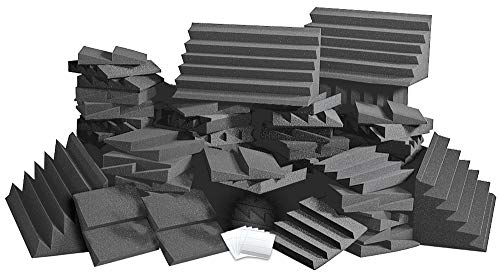
Auralex Alpha-DST Roominator Kit, Charcoal Panels

ATS 24 x 24 x 4 Bass Trap

Otoolling Hanging Baffles with Cables, Blue

FOROOMACO Corner Bass Traps, 4 Pack

FOROOMACO Grid Foam Panels, 12 Pack

Mybecca Bass Traps 12 x 6 x 6, 4 Pack

ua acoustics PULSE Sonoma Bass Traps, Black
The Strengths Of Each Pick
A small recording room often needs treatment on several surfaces, not just one corner. The Auralex Alpha-DST Roominator Kit, Charcoal Panels combines 32 DST112 panels, 32 DST114 panels, four LENRD bass traps, and two TTPRO monitors in one coordinated package. You can address wall reflections, corners, and listening positions without assembling a custom treatment plan from separate pieces.
Unlike a single decorative corner trap, this kit provides a more complete starting point for a compact studio. The honest catch is scale: 70 included components call for careful placement and a second pair of hands during setup. In a very small room, a smaller targeted setup may feel more manageable.
Real-World Strengths
- Multiple panel sizes support a planned treatment of walls, corners, and monitor positions.
- The broad kit reduces the need to match separate charcoal-finished pieces.
- Its focus on small studios makes the selection accessible to first-time room designers.
- Foam-based pieces can be moved as you learn how your room responds.
- The included variety gives you options without starting with a single-purpose trap.
Points To Keep In Mind
- The number of pieces requires a placement plan and enough wall, ceiling, and corner space.
- Use the kit as a coordinated treatment, not as a substitute for measuring your room accurately.
Key Specs
Made For Small Studios
You benefit most from this kit in a compact home studio where several acoustic problems need addressing at once.
Where A Sibling Pick Shines
Mybecca Bass Traps 12 x 6 x 6, 4 Pack offers a simpler corner-focused setup when wall coverage and monitor accessories aren’t priorities.
When your main concern is low-frequency energy collecting along a wall or corner, the ATS 24 x 24 x 4 Bass Trap gives you a substantial square face. Its open wood frame houses a mineral wool core, a material made to absorb sound rather than simply block it. A reflective membrane also helps manage higher-frequency energy around the same treatment area.
That layered construction distinguishes it from the shallow FOROOMACO Grid Foam Panels, which are better suited to broad reflection control. At four inches deep, the ATS panel still has a more modest profile than the 12-inch FOROOMACO corner traps, so measure the corner and wall junction before ordering.
The Case For It
- The mineral wool core is designed to absorb low-range reflections that tend to linger in a room.
- A 24-inch square face gives you useful coverage without the pointed shape of a pyramid trap.
- The charcoal finish blends discreetly into many studio interiors.
Trade-Offs To Consider
- The four-inch depth may be modest for a room with severe low-frequency buildup.
- You still need to account for the panel’s full depth when positioning it against a wall.
Technical Sheet
Built With In Mind
This panel suits you when you want a clean, square treatment for a recording studio or serious listening room.
A Better Fit Elsewhere
FOROOMACO Corner Bass Traps, 4 Pack provides greater treatment depth for a room where ceiling corners have adequate space.
Your floor space may be more valuable than another wall-mounted panel, especially in a multipurpose studio or office. The Otoolling Hanging Baffles with Cables, Blue suspend high-density polyester fiber treatment from the ceiling, adding absorption without taking up usable wall area. The blue finish also makes the treatment feel like part of the room rather than a gray utility panel.
These are hanging baffles, not deep triangular corner traps, so treat them as broad sound-absorbing elements rather than a substitute for dedicated low-frequency treatment. You may find them most effective in offices, podcast rooms, and studios where reflections around desks and monitors need attention.
A Few Highlights
- Four included steel cables support overhead placement.
- Suspended panels preserve floor and wall space in compact rooms.
- Polyester fiber gives the baffles a light, manageable form.
Practical Considerations
- Check the ceiling structure and use appropriate mounting hardware at each suspension point.
- The baffles are less direct than a deep corner trap for persistent low-frequency buildup.
- Blue may be a deliberate visual accent in a bright workspace.
Who Will Love This
You will appreciate this option in a modern office, podcast room, or studio where ceiling coverage matters more than matching dark wall panels.
Another Choice May Suit
ATS 24 x 24 x 4 Bass Trap fits you better when a wall-mounted, low-frequency-focused panel is more practical than suspended décor.
The hardest-working low-frequency corners are often the ceiling intersections where two walls meet. FOROOMACO Corner Bass Traps, 4 Pack uses triangular pyramid forms that fit into those three-surface junctions. Each trap has a 16.5-inch face, extends 12 inches into the corner, and uses porous open-cell polyurethane foam.
That depth makes it more purpose-built for low-frequency buildup than the two-inch FOROOMACO Grid Foam Panels. The trade-off is shape: a pyramid works neatly in a ceiling corner, while the ATS 24 x 24 x 4 Bass Trap offers a more conventional square face for broader wall placement.
The Good Stuff
- The triangular form fills awkward wall-and-ceiling junctions without a bulky rectangular box.
- Twelve inches of depth gives the foam more depth than standard wall tiles.
- Four traps allow a coordinated treatment across several room corners.
- The black finish suits many neutral studio and media-room interiors.
Small Caveats
- Measure the ceiling junction because the 12-inch depth needs clearance.
- The pointed shape is less versatile for wall-mounted coverage than a square panel.
Quick Facts
The Right Fit
You benefit most in a project studio or media room with exposed ceiling corners and enough clearance for deep foam traps.
Look Elsewhere When
Mybecca Bass Traps 12 x 6 x 6, 4 Pack offers a slimmer profile where the ceiling corner lacks room for a 12-inch pyramid.
Flutter echo is the rapid series of reflections you hear between parallel walls, often noticeable during conversation or recording. FOROOMACO Grid Foam Panels, 12 Pack gives you twelve 12.6-inch-square foam tiles for placing around desks, microphones, speakers, and first reflection points. Their open-cell structure absorbs sound across the face rather than redirecting it.
Despite their place in this bass-trap roundup, these are mainly reflection-control panels rather than deep corner traps. Compared with the ATS 24 x 24 x 4 Bass Trap, their two-inch depth and smaller face suit broader surface coverage. You gain flexibility, but not the low-frequency depth of a substantial corner treatment.
What It Does Well
- Twelve panels provide several placement options around a work area.
- The grid face creates a consistent appearance across a wall or ceiling.
- Two-inch depth makes the tiles practical for reflection points and creative offices.
Where It May Fall Short
- Two inches of depth is limited for persistent low-frequency buildup.
- The square shape doesn’t fill ceiling corners as efficiently as a triangular trap.
- Twelve pieces can create visual repetition unless you stagger their placement.
Who Should Grab It
This set suits you for podcasting, streaming, office recordings, or general wall treatment where reflections matter more than deep bass control.
Swap It Out When
ua acoustics PULSE Sonoma Bass Traps, Black is a more appropriate choice when low and mid frequencies dominate your room concerns.
You don’t always need a ceiling-filling trap to begin improving low-frequency reflections. Mybecca Bass Traps 12 x 6 x 6, 4 Pack provides four charcoal foam traps with a slim 12-by-6-inch face and six-inch depth. Each piece is approximately eight inches across its angled face, making the set practical for corners that can’t accommodate larger panels.
For a rehearsal room or compact home studio, the four-piece format provides a manageable start. The ATS 24 x 24 x 4 Bass Trap has a larger square face and a mineral wool construction, while the Mybecca pieces prioritize a narrow footprint and a simpler foam treatment.
Useful Touches
- Four corner traps make it straightforward to treat more than one junction.
- The narrow 12-by-6-inch face suits tighter corners and simpler layouts.
Small Limitations
- Each trap has a smaller face than the square ATS treatment.
- The six-inch depth falls between shallow grid foam and the deeper FOROOMACO pyramids.
- Measure the corner angle carefully before arranging all four pieces.
Feature Facts
Right Fit For
You benefit most in a tight home studio, rehearsal room, or small listening area with several usable corners.
Consider Something Else
Otoolling Hanging Baffles with Cables, Blue fits you better when preserving floor space matters more than corner treatment.
A corner treatment shouldn’t have to look like an industrial foam block. The ua acoustics PULSE Sonoma Bass Traps, Black pair narrow corner traps in a velvet-covered, perforated wood design. The internal acoustic foam targets low and mid frequencies, while the finished exterior gives you a more furniture-like appearance for a home theater, office, or music room.
Each trap measures 50 by 23 centimeters, creating a slimmer profile than the square ATS 24 x 24 x 4 Bass Trap. You can position them between walls or at wall-and-ceiling intersections, depending on the room geometry. The two-piece format makes them useful for targeted treatment rather than a complete room plan.
Where It Excels
- The velvet finish suits rooms where visible treatment should coordinate with furnishings.
- Perforated wood and internal foam provide a layered construction.
- The narrow dimensions fit selected corners more neatly than a broad square panel.
- Low- and mid-frequency treatment suits music rooms, theaters, and offices.
Details To Watch
- Only two traps are included, so multiple corners require additional sets.
- The fabric-covered construction is less suited to exposed industrial decor than plain foam.
Core Details
Whose Shelf It Belongs On
You benefit most in a home theater, music room, or office where low-frequency control and a finished appearance both matter.
Reach For A Different Pick When
FOROOMACO Corner Bass Traps, 4 Pack fits you better when you need greater treatment depth and a four-piece ceiling-corner set.
What to Match to Your Room
Room Shape and Placement
Start with the surfaces causing the problem. Bass traps work by absorbing low-frequency energy, so corners and wall-ceiling intersections deserve attention first. Floor-to-ceiling corner traps suit rooms with unused corners, while hanging baffles work well where floor space is limited. Measure the junction before selecting a shape.
Depth and Absorption
Depth affects how much porous material sits behind the visible face. A 12-inch pyramid offers substantially more treatment depth than a two-inch grid tile, and a six-inch corner trap falls between the two. Low-frequency buildup generally calls for greater depth, while reflections around desks and speakers can often be handled with shallower panels.
Appearance and Setup
Charcoal foam disappears into many studios, while velvet-faced traps coordinate more readily with home furnishings. Hanging panels require secure ceiling mounting, while corner and wall treatments need accurate positioning. Choose the installation method your space can support rather than forcing a decorative shape into an unsuitable location.
Avoiding Common Treatment Mistakes
Mistakes Worth Dodging
Don’t judge a room by one treatment placed in the first available corner. Low-frequency energy can collect in several directions, so a measured layout usually produces more balanced results. Avoid covering every surface with shallow foam, since deep corners and first reflection points often deserve attention first.
What The Higher Tier Buys
Costlier treatments commonly add depth, layered materials, or a more refined exterior. Those features help when you need stronger low-frequency absorption or a treatment that belongs in a finished living space. A simple foam set remains more practical for a small office, rehearsal room, or secondary studio.
Frequently Asked Questions
Do Bass Traps Work in Every Room?
Bass traps can help with low-frequency reflections, but room dimensions and construction shape the result. Placement matters as much as the product itself.
Are Thicker Bass Traps Better?
Greater depth usually gives you more porous material for absorbing low-frequency energy. Choose the depth your corners can accommodate rather than selecting the largest option.
Can Acoustic Foam Replace Bass Traps?
Thin acoustic foam is better suited to reflections and flutter echo than persistent low-frequency buildup. Deep corner traps or layered panels are more practical for bass control.
Do Corner Bass Traps Require Special Installation?
Most need careful measuring and secure placement, while suspended baffles also require suitable ceiling mounting. Check the surface and hardware requirements before installation.
How Many Bass Traps Does a Room Need?
The count depends on room size, shape, and where reflections become noticeable. A four-piece set can cover several corners, but a full treatment may require more placements.
Final Verdict
The right bass trap matches the room’s problem, available depth, and tolerance for a visible treatment. Auralex offers the most complete small-studio package, while FOROOMACO, ATS, Mybecca, and ua acoustics cover more specific shapes, depths, and finishes. Measure first, then choose the option that solves your room without crowding it.