A folder of passports, deeds, certificates, and backup drives can disappear in a fire, flood, or hurried move. You need a document safe that matches the risk, location, and daily access routine, from a portable file box in a closet to a larger steel safe bolted into place. The eight options below cover different balances of capacity, portability, locking systems, and emergency protection so you can choose without paying for space or features you’ll never use.
A Quick View Of The Lineup

Tamfile Fireproof Document Box

VIDXCVIT 5.2 Cuft Fireproof Safe

Crinwaki X Large Fireproof Document Box
SentrySafe SFW205GQC Gray Steel Floor Safe

SentrySafe SFW123GDC 1.23 Cuft Digital Safe
SentrySafe SFW205CWB Black Floor Safe

Psisuvry 3.3 Cuft Fireproof Home Safe

VIDXCVIT 3.4 Cuft Digital Safe
The Strengths Of Each Pick
A fireproof document box earns its keep when your important papers must move between a home closet, an office, and a temporary location. The Tamfile combines a rigid shell, silicone-coated fiberglass layers, a combination lock, and a shoulder strap, giving it a more portable profile than the steel safes later in this list.
Its large format also pulls double duty as a file organizer. You can sort passports, certificates, cards, media, and smaller valuables without creating one bulky pile, which makes it especially useful in apartments, dorm rooms, and homes where floor space is limited.
Notable Gains
- The eight-layer shell is designed to slow heat transfer while resisting fire, water, dust, and humidity.
- Twenty-four folders, card slots, pen holders, and mesh pockets keep papers and small valuables separated.
- The combination lock and reinforced metal zipper add two layers of closure during travel.
- A detachable shoulder strap and sturdy handle make the box more manageable than a loose document carrier.
- The UL 94 V-0/5VA designation is a material flammability rating, not a stated fire-duration rating for the complete box.
Small Caveats
- At 15.7 by 11.8 by 6.9 inches, it needs a shelf or storage surface with enough room for the complete case.
- Its many interior sections may take longer to sort than a simple empty compartment, especially during an evacuation.
Key Specs
Built With In Mind
This box fits people who need portable document protection and detailed filing rather than a walk-in-style steel enclosure.
Where Another Pick Suits Better
The VIDXCVIT 5.2 Cuft Fireproof Safe offers more volume and adjustable shelving for documents that stay in one fixed location.
Unlike the Tamfile’s flexible filing layout, the VIDXCVIT 5.2 Cuft Fireproof Safe focuses on a large, fixed storage volume. Three removable shelves can separate records, media, jewelry, and other belongings, while the 12.2 by 14.96 by 23.62-inch body gives you room to change the arrangement as storage needs shift.
The keypad supports private daily access, and two spare keys provide a separate way into the safe. Pre-drilled mounting points matter for a home safe because a unit left easy to carry away adds little protection in a theft scenario.
Everyday Wins
- Three heavy-duty 20 mm locking bolts resist attempts to pry or force the door.
- Removing shelves creates a taller opening for items that do not fit standard divisions.
- The interior light activates when the door opens, helping in dark closets and hallways.
- Two spare keys provide physical access when the keypad is unavailable.
- Expansion screws allow the safe to be secured to a wall, closet, or floor.
Practical Considerations
- The steel body and five-plus-cubic-foot capacity call for a sturdy floor and two people when moving it.
- A keypad creates a code-memory routine, so keep the spare keys secure but separate from the safe.
At A Glance
Made For
Households that keep records, media, and valuables together will appreciate the room and flexible interior arrangement.
Consider Something Else When
The Tamfile Fireproof Document Box is easier to carry between locations and offers more built-in file organization.
A smaller lockbox can make sense for the documents you need to grab quickly, especially when a full safe would dominate the available space. The Crinwaki uses a double-layer steel structure with insulating material between the layers, adding a different protective approach from the fiberglass construction of the Tamfile.
Its 13.2 by 11 by 4.13-inch profile is more compact, yet the box is intended for passports, cash, a tablet, and other personal items. A mechanical key lock also keeps daily access straightforward without introducing a keypad battery or electronic code into the equation.
Where It Helps
- The layered steel and insulating core provide a rigid enclosure for portable records.
- The key lock gives you a direct mechanical way to open the box.
- The stated dimensions are easier to accommodate on a shelf than a full-size floor safe.
- Its broad item range suits mixed document and electronics storage.
Points To Note
- The shallow shape works better for flat records and small valuables than for large binders.
- Its 4.13-inch depth gives less internal flexibility than the Tamfile’s multi-pocket file box.
Right Fit For
This box suits people protecting a smaller set of passports, cards, cash, or portable electronics for home and travel.
A Better Fit Elsewhere
The Tamfile Fireproof Document Box offers more built-in organization for families that keep many separate document categories together.
The SentrySafe SFW205GQC takes a balanced approach to permanent home storage, combining 2.05 cubic feet of capacity with fire and water protection. Its gray steel body, pry-resistant hinge bar, digital keypad, and interior lighting make it more practical for daily filing than the smaller Crinwaki lockbox.
The included key rack, door tray, and door pocket give important papers a fixed home. For a busy home office, that organization can make a meaningful difference, especially when you open the safe in a dim closet or need to find one folder without unpacking the entire interior.
Where It Excels
- UL Classified fire protection provides a stated listing for the complete safe.
- ETL Verified water protection adds coverage for flooding and moisture events.
- The digital keypad supports quick access without handling a physical key.
- The interior light makes documents and small belongings easier to locate.
- Built-in racks and door storage separate frequently used items.
Trade-Offs To Consider
- A floor safe needs a suitable location with enough clearance for the door and surrounding floor area.
- Its 2.05-cubic-foot interior offers less room than the larger 3.3- and 3.4-cubic-foot options.
Quick Facts
Who It Suits Best
Home offices and households seeking a fixed safe with straightforward electronic access will find this format practical.
Reach For A Different Pick When
The SentrySafe SFW123GDC 1.23 Cuft Digital Safe suits you better when detailed flood and fire exposure ratings matter more than interior volume.
Protection ratings become meaningful when they describe a specific exposure rather than simply calling a box fireproof. The SentrySafe SFW123GDC provides unusually clear information: it is rated for one hour at 1700°F, a 15-foot fall during a fire, and 24 hours in water as deep as eight inches.
That level of detail makes it easier to compare this 1.23-cubic-foot safe with the broader claims attached to the VIDXCVIT models. You still need to consider whether your papers and media can tolerate the conditions, since a fire-resistance rating describes the enclosure rather than the condition of every item inside.
Positive Points
- The stated 1700°F fire rating provides a defined heat-exposure scenario.
- ETL Verified water protection covers 24 hours at a depth of up to eight inches.
- The 15-foot fall rating addresses a common hazard during a building fire.
- A programmable keypad gives you repeatable access without a mechanical dial.
- The compact 1.23-cubic-foot size works well in a cabinet or discreet floor location.
Less Ideal Details
- The water rating covers a stated depth and duration, not every possible flood condition.
- Its capacity is smaller than the SentrySafe SFW205GQC and the 3.3-cubic-foot Psisuvry safe.
Who Should Grab It
You should consider this model when documented fire, flood, and fall ratings influence your decision more than maximum storage volume.
Another Choice May Suit
The SentrySafe SFW205GQC Gray Steel Floor Safe offers more capacity and an interior light for larger document collections.
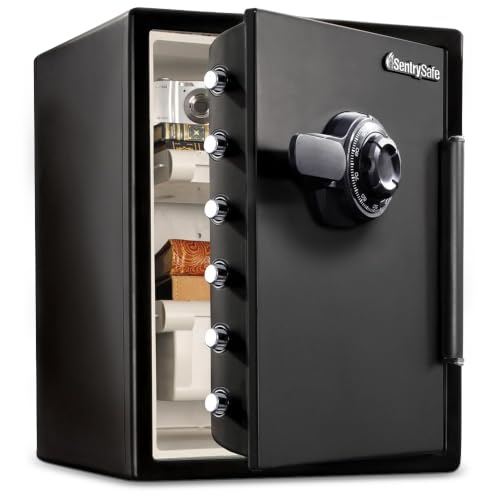
The SentrySafe SFW205CWB shares the 2.05-cubic-foot format of the gray digital model but takes a more mechanical route. Its preset combination dial avoids electronic entry, while six large one-inch bolts and a pry-resistant hinge bar form the physical security system.
For an office or apartment where you do not want to manage a keypad code, that simplicity has real appeal. The combination requires deliberate entry, and the black finish is intended to blend into a floor or cabinet setting more discreetly than the gray model.
Noteworthy Benefits
- Six one-inch locking bolts create a more substantial door-locking arrangement.
- The pry-resistant hinge bar supports resistance to forced entry.
- UL Classified fire and ETL Verified water protection cover two common household risks.
- The mechanical dial avoids relying on electronic controls for routine access.
- The 2.05-cubic-foot interior provides a practical balance of room and footprint.
Factors To Consider
- A combination dial takes a little more attention to enter than a keypad.
- You must remember the preset combination and keep it accessible through a secure record.
Technical Highlights
The Right Fit
This floor safe suits offices and homes that prefer a mechanical combination over electronic entry for stored documents.
Not Your Match When
The SentrySafe SFW205GQC Gray Steel Floor Safe fits you better when quick keypad entry and an interior light suit your routine.
Three cubic feet of storage is often the point where a home safe can hold more than a single document box without becoming a small cabinet. The Psisuvry provides 3.3 cubic feet, solid steel construction, and a removable shelf or partition, giving you room for records, money, jewelry, and travel documents in one enclosure.
Its access system combines a digital keypad with a physical key, so the safe supports quick routine opening and a backup method. At 19.69 by 13.78 by 12.2 inches, it also needs a defined floor or cabinet position rather than a casual shelf spot.
Strong Points
- The 3.3-cubic-foot interior holds substantially more than the smaller SentrySafe model.
- Digital and physical access methods offer convenient daily use with a backup route.
- Solid steel construction creates a rigid body for the stored contents.
- The removable shelf or partition can be rearranged around larger belongings.
- Fire and water protection make it relevant to records kept in mixed household environments.
Small Limitations
- The 3.3-cubic-foot format demands more placement space than the 1.23-cubic-foot SentrySafe.
- Store the backup key somewhere separate from the safe so it remains useful after the primary access method is forgotten.
Whose Shelf It Belongs On
This safe works for households storing many records and small valuables together in a dedicated home or office area.
Swap It Out When
The SentrySafe SFW123GDC 1.23 Cuft Digital Safe is the better fit where compact placement and specific exposure ratings take priority over volume.
The VIDXCVIT 3.4 Cuft Digital Safe brings together the largest stated capacity in this group with electronic and physical entry. It is aimed at mixed storage, including documents, money, jewelry, firearms, and medicines, which makes the interior volume more important than the narrow file-box format used by the Crinwaki.
Its fire and water protection broaden the intended use beyond ordinary concealment. In a shared home, a keyed backup can be useful for adults who do not need to remember the keypad code, provided the key is stored responsibly.
What Helps Most
- Three-point-four cubic feet provides useful room for mixed documents and valuables.
- The electronic keypad supports quick access for routine use.
- A physical key offers a separate access route for another trusted adult.
- Fire and water protection suit records kept where household emergencies are a concern.
- The broad storage purpose suits families combining records with other valuable belongings.
Potential Drawbacks
- Its large cabinet-style format needs more floor space than the compact SentrySafe models.
- Physical security does not replace temperature-controlled storage for medicines that require specific conditions.
Feature Facts
Best Suited To
Shared households needing roomy, dual-access storage for documents and assorted valuables will find this model relevant.
Look Elsewhere When
The VIDXCVIT 5.2 Cuft Fireproof Safe offers more capacity, adjustable shelves, and mounting points for a more flexible interior.
What Matters Before You Buy a Document Safe
Capacity and access
Start with the contents, not the exterior dimensions. A passport folder, a stack of legal records, and several binders occupy very different amounts of space, and a safe marketed by cubic volume may not offer the internal dimensions you need. Measure binders, laptops, and storage boxes before buying, then compare those measurements with the usable interior space.
Access style should match your routine. A keypad is convenient for frequent use, a mechanical dial avoids electronic controls, and a key can be useful for shared access. Portable cases need a handle or strap, while fixed safes need consideration of floor strength, door clearance, and anchoring points.
Protection beyond the label
A fire-resistance listing describes performance under a stated condition, often including temperature and duration. A waterproof rating may similarly specify a water depth and exposure time, so two boxes using similar words can cover very different risks.
UL Classified and ETL Verified are third-party classifications that give you more information than an unsupported protection claim. Look for the complete rating rather than assuming every document, battery, or electronic device will emerge undamaged, since paper and electronics have their own heat and moisture limits.
Placement and installation
The best safe is one that remains usable in its intended location. A floor safe needs enough clearance for the open door, while a wall- or closet-mounted model needs a suitable surface and proper fasteners. Portable document boxes provide more flexibility, but a bulky organizer can become difficult to carry during a hurried departure.
Check door swing, shelving, and nearby furniture before finalizing your choice. You should also decide where spare keys or emergency access records will live, because a backup kept beside the safe offers little value.
Lock style and routines
A digital keypad makes sense when you can remember the code and keep the spare keys secure. Mechanical combinations work well for people who prefer fewer electronic parts, although entering the code takes more care. Combination locks and key locks also require you to record access details somewhere sensible.
Document access frequency matters too. A large safe positioned inconveniently may encourage you to leave sensitive papers elsewhere. Place the safe where routine use is realistic, while keeping it away from obvious sightlines.
Common Mistakes Worth Dodging
Common Shopping Slip Ups
The most common mistake is judging protection by capacity alone. A large safe with an inconvenient door or poor internal layout may suit you less than a smaller model that fits its documents neatly. Another common error is assuming “fireproof” describes every item inside; the enclosure rating and the contents’ sensitivity are separate questions.
What Separates Premium From Basic
Higher-tier models often spend money on stronger steel, more precise protection ratings, larger bolt arrangements, better interior organization, and installation hardware. Those additions help when your documents face meaningful fire, flood, or theft risks. For lighter-duty storage, a portable box with a solid lock may cover the need without taking on a larger steel cabinet.
Frequently Asked Questions
Are document safes actually fireproof?
A fireproof safe is designed to slow heat transfer under a specified condition. The strongest comparison includes temperature, duration, and listing details rather than the word “fireproof” alone.
Is a portable document box safer than a floor safe?
A portable box wins for flexibility, transport, and organized filing, while a floor safe usually offers more volume and stronger physical construction. Your location and emergency risks should determine which format fits.
Should you choose a keypad, dial, or key lock?
Choose a keypad for frequent electronic access, a dial for mechanical entry, and a key lock when another person may need simple access. Record any combination or key location in a secure record.
How much capacity do you need for documents?
Measure the thickness of your binders, laptops, and document boxes before choosing. Internal shelf dimensions matter as much as the stated cubic-foot capacity.
Where should you place a home document safe?
Choose a dry, accessible location with enough room for the door to open, and anchor fixed models according to the included mounting instructions. Portable boxes are better suited to closets, cabinets, and travel storage.
Closing Remarks
The right document safe depends on what you need to protect and how often you will open it. Tamfile leads the portable, organized-file approach, while the SentrySafe models offer fixed, roomier protection for home and office use. Measure your documents, review the protection ratings, and choose the smallest secure format that handles your actual storage routine.