A café closing at midnight, a church counting offerings after service, and a retail shop handling a night deposit all face the same problem: cash and small valuables need a protected place before the next person with authorized access arrives. A drop safe gives your team a way to deposit items without opening the main door, while a keypad, key lock, or fingerprint system controls later access. The right choice depends on capacity, mounting needs, and how many people handle the safe.
How The Shortlist Stacks Up
KAER 4.0 Cuft Depository Safe

Templeton T71 Mailbox Safe

Stealth DS1614 Depository Safe

KAER 1.6 CuFt All-Steel Drop Safe

KAER Dual-Zone 3.1 CuFt Drop Safe

KAER 70 lb 3.1 CuFt Drop Safe
KAER 1.8 CuFt Digital Drop Safe

Sanfnz 2.6 CuFt Drop Safe
More Details On Our Top Picks
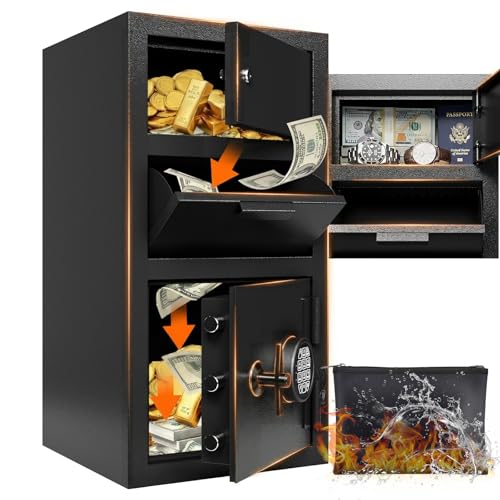
A café, church, or rental office can place cash and envelopes through the front slot without exposing the contents. Unlike the smaller T71 Mailbox Safe, this KAER combines a 4.0 cu ft interior with a keypad, emergency keys, and mounting points, giving your team more room without adding electronic complexity beyond routine code entry.
The front anti-fishing baffle, a jagged barrier designed to block retrieval tools, suits businesses with a controlled counter. You gain more storage than the compact KAER models, though the larger safe calls for a suitable floor or wall location.
Everyday Perks
- The 4.0 cu ft interior holds cash bags, contracts, receipts, and valuables together.
- Programmable 3-8 digit codes support regular staff access, while two emergency keys cover dead batteries.
- Back and bottom mounting holes allow you to secure the safe to concrete or a solid wall.
- Silent entry and lockout features support discreet overnight or low-traffic deposits.
Trade Offs
- The cabinet itself is not fireproof, so important papers need separate protection.
- Its capacity may be more than a home office or tiny reception area can accommodate.
Key Specs
Built With In Mind
You benefit most from this model in a café, church, or back-office space that handles frequent cash deposits and needs substantial interior capacity.
Another Choice May Suit
The Templeton T71 Mailbox Safe suits you better when a compact, keyed drop box fits your operation without electronics.
A small church office or neighborhood shop may prefer a drop box without a keypad to manage. The T71 offers a one-way slot for cash, keys, and paperwork, then uses a conventional keyed lock for retrieval. For your workflow, that simplicity can be a genuine advantage.
Unlike the KAER 4.0 Cuft Depository Safe, this compact unit emphasizes basic operation and a small footprint. It also suits sheltered outdoor placement, though wall security depends on attaching the safe to a suitable surface.
What Earns Its Place
- The keyed lock avoids code management, battery concerns, and fingerprint enrollment.
- Laser-cut solid steel provides a practical body for deposits and small valuables.
- Included mounting hardware helps you reduce the chance of someone removing the entire drop box.
Small Caveats
- Its 0.4 cu ft capacity suits small deposits rather than bulky cash bags.
- Outdoor use means sheltered placement, away from direct weather exposure.
- Anyone with the key can retrieve the contents, so control key custody carefully.
Quick Facts
The Right Fit
You suit this model best when your business needs a simple drop box, reliable wall anchoring, and minimal access-control administration.
Where A Sibling Pick Shines
The KAER 1.6 CuFt All-Steel Drop Safe fits you better when you need three access methods and a larger internal volume.
Retail staff depositing money after a close will appreciate the Stealth DS1614’s combination of a 44-pound steel body and a protected electronic lock. Its jagged anti-fishing baffle blocks narrow retrieval tools, while the drop opening keeps the main door shut during deposits.
Compared with the Templeton T71 Mailbox Safe, this model offers heavier construction and electronic access, but it occupies more room. The external dimensions are 16 by 14 by 14 inches, making counter and mounting space important parts of your decision.
A Favorable Mix
- The quarter-inch steel door adds substantial material around the opening.
- Two one-inch solid steel bolts lock the door from the interior side.
- The electronic lock can have its battery replaced from outside the safe.
- Two mounting holes and included hardware support a fixed installation.
Points To Note
- The 44-pound body is less convenient to reposition than the T71.
- Its rectangular size calls for more clearance than a compact mailbox-style safe.
Made For
You benefit most from this safe in a retail shop with a secured back room and enough space for a floor or wall-mounted steel cabinet.
Look Elsewhere When
The KAER 70 lb 3.1 CuFt Drop Safe suits you better when a deeper interior for cash bags matters more than the DS1614’s more compact body.
A small café counter can run out of floor space quickly, making the 1.6 cu ft KAER a practical fit to measure first. You receive fingerprint, password, and mechanical-key access, plus a front slot for cash, checks, and keys. In practice, that mix covers fast staff entry and a backup route.
Unlike the Stealth DS1614 Depository Safe, this model is lighter at 44 pounds and offers dual authentication, meaning both a fingerprint and password are required in that mode. The four solid steel bolts and 12-gauge body keep the construction focused on a compact footprint.
Practical Pluses
- You can store up to 20 fingerprints for regular staff access.
- Custom 3-8 digit codes provide a second access method.
- Silent mode supports discreet deposits during quiet business periods.
- Wall or floor mounting helps keep the safe fixed in place.
Trade-Offs To Consider
- Its 1.6 cu ft interior is best for modest deposits, not large cash bags.
- Fingerprint access and dual verification require more setup than a keyed lock.
Feature Snapshot
Who Should Grab It
You suit this model best when counter space is tight and several staff members need quick access to a compact drop safe.
Reach For A Different Pick When
The Templeton T71 Mailbox Safe fits you better when you prefer one keyed mechanism and have little need for electronic access.
Your daily cash and your manager’s valuables do not always need to share the same compartment. The KAER Dual-Zone 3.1 CuFt Drop Safe separates them, with a keyed upper section and a biometric lower vault. That separation gives a pharmacy, church, or retail manager a cleaner access hierarchy.
Unlike the single-compartment KAER 1.6 CuFt All-Steel Drop Safe, this model gives you two distinct storage zones. Its 74-pound body and reinforced bolts add mass, while the front slot lets staff deposit without opening the lower door.
What Helps Most
- Two compartments separate daily revenue from petty cash, keys, and valuables.
- The lower vault accepts fingerprints, codes, backup keys, and dual-mode authentication.
- A deep jagged baffle protects the one-way deposit opening.
- Silent mode helps with low-noise night deposits.
Honest Caveats
- The two-zone design is unnecessary for a business storing only small daily deposits.
- Its 74-pound weight makes repositioning less convenient.
- Floor mounting requires a structurally suitable location.
Who Will Love This
You benefit most from this model when a manager needs separate storage for daily deposits and higher-value items such as keys or receipts.
A Better Fit Elsewhere
The KAER 1.6 CuFt All-Steel Drop Safe suits you better when a single compact compartment and flexible wall or floor placement are enough.
Restaurants, food trucks, and rental offices often need more usable depth than a compact cabinet offers. The KAER 70 lb 3.1 CuFt Drop Safe measures 27.2 by 14 by 14 inches internally, giving deposit bags and document folders room to sit without forcing them into the door opening.
Compared with the dual-zone KAER, this model offers one large vault rather than separate access levels. You can still use a fingerprint, password, or mechanical key, while a 12-gauge steel body and five steel bolts support a commercial installation.
Useful Strengths
- The deep interior accommodates larger cash drawers and deposit bags.
- Fingerprint storage supports up to 20 authorized users.
- Three active bolts plus two hinge-side deadbolts secure the door area.
- Wall and floor mounting options suit different room layouts.
Details To Watch
- Its 70-pound weight calls for careful placement and lifting.
- The narrow 14-inch depth still needs accurate space planning.
Core Details
Whose Shelf It Belongs On
You suit this model best when a restaurant, retail shop, or office needs a deep deposit compartment and several electronic access options.
Another Choice May Suit
The KAER Dual-Zone 3.1 CuFt Drop Safe fits you better when separate manager access and daily deposit storage matter more than a single large compartment.
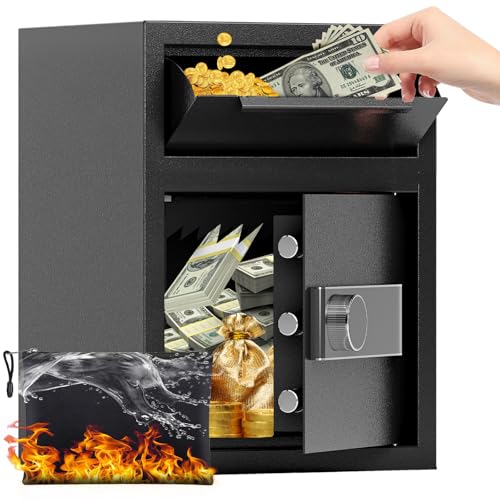
A home office, small studio, or reception desk can gain a protected deposit point without dedicating an entire cabinet. The 1.8 cu ft interior gives you room for cash, envelopes, and paperwork, while a front slot handles deposits without opening the main door.
Unlike the 4.0 cu ft KAER model, this safe aims at a more compact setup. A password and key provide manager access, and the serrated end of the security baffle discourages someone from reaching into the deposit opening with a retrieval tool.
Why It Works Well
- The 1.8 cu ft capacity balances useful storage with a compact footprint.
- Front deposit access keeps the main door closed during a drop.
- Password and key access give you two ways to open the safe.
Small Caveats
- Digital access requires careful code management among staff.
- The capacity suits smaller envelopes and cash bundles rather than bulky bags.
- Your installation location should allow the door to open fully.
Who It Suits Best
You benefit most from this safe in a home office, studio, or small reception area that needs compact digital deposit storage.
Consider Something Else When
The Templeton T71 Mailbox Safe fits you better when a simple keyed lock and wall-mounted mailbox format match your routine.
A shop that receives bills, checks, and night cash can use the Sanfnz 2.6 CuFt Drop Safe as a straightforward central point. The front slot handles contact-free deposits, while the main compartment provides usable room for the items waiting for your manager.
Compared with the 70-pound KAER model, this safe has a similar volume but a less elaborate access story. Its saw-tooth tilting baffle helps block fishing attempts, making the deposit path the main focus. You will want to confirm its access method and mounting arrangement suit your counter.
The Upside
- The 2.6 cu ft capacity offers useful room without a cabinet-sized footprint.
- Front deposits let staff place cash or checks without opening the main door.
- The tilting saw-tooth baffle adds protection at the deposit opening.
Practical Considerations
- Confirm that your intended access method fits your staff routine.
- Allow enough room to reach the slot and open the main door.
- A sturdy mounting point is important for a business drop box.
Quick Facts
Perfect Match For
You suit this model best when a small or midsize business needs a protected deposit point for cash, bills, and checks.
Where Another Pick Shines
The KAER 70 lb 3.1 CuFt Drop Safe fits you better when fingerprint access, a deeper interior, and several steel bolts are priorities.
Match the Safe to Your Daily Deposit Routine
Start With the Deposit Flow
Watch how staff handle money after a shift ends. A quick front slot works well for nightly deposits, while a larger hopper may suit envelopes and bundles. Your process should avoid leaving cash unattended while someone opens the main door.
Match Capacity to Daily Volume
Small deposits suit the 0.4 cu ft Templeton T71, while busy restaurants may prefer the deeper 3.1 cuft KAER models. Measure the available counter, shelf, or floor area before choosing, including clearance for the open door and handle.
Plan Mounting and Access
An anti-fishing baffle protects the deposit opening, but a fixed installation adds protection against the entire safe being removed. Concrete floors and solid walls provide the anchoring surfaces named across several models.
Choose the Lock Around Your Team
A keyed lock reduces electronic administration. Fingerprint access speeds up daily entry, while a password provides a familiar alternative. Dual authentication adds another layer, although it also requires clearer access rules.
Avoid Common Drop Safe Pitfalls
Wrong Turns To Avoid
Do not choose by capacity alone, since a large safe still needs room to open. Check the deposit opening, access method, and mounting surface together. Make sure staff can deposit items without blocking a customer-facing counter.
What Separates Premium From Basic
Premium models often add larger steel bodies, more locking bolts, biometric access, or separate compartments. Those upgrades help when several people share access or when daily deposits are substantial.
Frequently Asked Questions
What size drop safe does a small business need?
The right size depends on your deposit volume and available space. A 0.4 to 1.8 cu ft model suits smaller operations, while 2.6 to 4.0 cu ft options provide more room for cash bags, documents, and valuables.
Are wall-mounted drop safes secure for business use?
Wall mounting can help stop someone from removing the entire safe. Security still depends on the wall material, mounting hardware, lock quality, and the protected design of the deposit slot.
What is an anti-fishing baffle?
An anti-fishing baffle is an internal barrier designed to block hooks or narrow retrieval tools. It helps protect deposits that travel through the front slot without requiring the main door to open.
Should a small business choose a keyed or digital safe?
A keyed safe suits simple access and minimal administration. A digital safe offers codes, fingerprints, or both, which can suit teams needing quicker or more controlled entry.
Can a drop safe hold documents and valuables?
You can use many models for cash, checks, keys, receipts, and small valuables. Confirm the interior dimensions and use a separate fire-resistant document pouch for papers that need separate protection.
Final Verdict
A small business gets the most from a drop safe that matches its deposit volume, access routine, and available mounting space. The KAER 4.0 Cuft Depository Safe suits larger cash operations, the T71 offers uncomplicated keyed storage, and the Stealth DS1614 balances compact dimensions with reinforced construction. Measure first, then choose the access system your team will use consistently.